

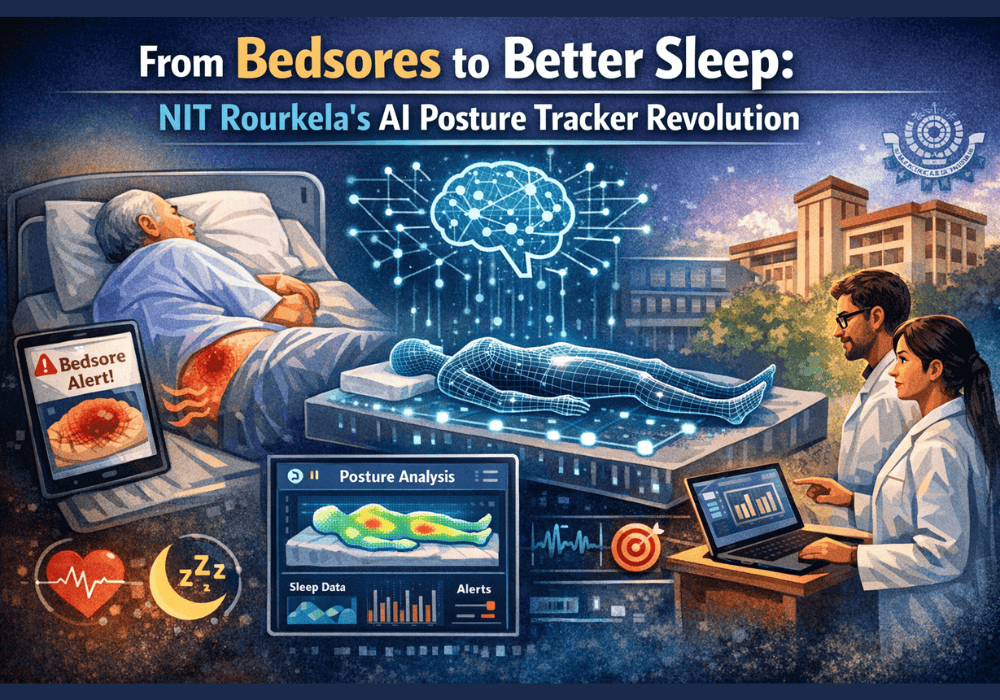
Author – Ritesh Ranjan: Sleep posture plays a critical role in overall health, especially for patients who are bedridden, elderly individuals, and people suffering from sleep disorders. However, monitoring sleep posture has always been a challenge due to privacy concerns, blankets covering the body, and the discomfort caused by wearable devices.
Now, researchers at NIT Rourkela have developed an AI-powered sleep posture tracking system that works even under blankets with 98% accuracy, potentially transforming patient care in hospitals, elderly care homes, and sleep clinics.
Published in the IEEE Sensors Journal, this innovative system uses thermal imaging, depth sensors, and pressure sensors to monitor sleep posture without using cameras, making it privacy-safe and highly effective.
Sleep Posture Crisis: Why Tracking Matters
Sleep posture is not just about comfort — it directly impacts health. Poor sleep posture can lead to serious health issues such as:
- Chronic back and neck pain
- Sleep apnea
- Acid reflux
- Bedsores in bedridden patients
- Poor blood circulation
According to health estimates, millions of patients suffer from bedsores and sleep-related disorders due to improper posture and lack of monitoring. In hospitals, nurses must manually check patients every few hours to prevent bedsores, which increases workload and still leaves room for error.
Wearable devices are uncomfortable for long-term use, and camera-based monitoring raises privacy concerns. This created a major need for a non-contact, privacy-safe posture monitoring system, which is exactly what NIT Rourkela has developed.
NIT Rourkela’s AI Solution: How the Technology Works
The NIT Rourkela AI Sleep Posture Tracker uses a combination of three sensors and artificial intelligence to track body posture accurately.
Multi-Sensor System
| Sensor | Function | Works Under Blanket |
| Thermal Sensor | Detects body heat signature | Yes |
| Depth Sensor | Captures 3D body shape | Yes |
| Pressure Sensor | Tracks weight distribution | Yes |
AI Technology Behind It
The system uses Generative AI and Graph Neural Networks (GNN) to detect body joints and posture positions. It can accurately classify sleep postures such as:
- Supine (lying on back)
- Side sleeping
- Prone (lying on stomach)
Even if a patient is covered with a blanket or the room is dark, the system still works because it does not rely on RGB cameras. This makes the system privacy-friendly and hospital-safe.
According to Prof. Saptarshi Chatterjee from the ECE Department, lab tests showed 98% posture classification accuracy, which is extremely high for a non-contact monitoring system.
Real-World Applications: Hospitals to Homes
This technology can be used in multiple healthcare environments.
1. Hospitals and ICUs
Bedridden patients are at high risk of bedsores due to staying in the same position for too long. This system can automatically alert caregivers when a patient needs repositioning, potentially reducing bedsores significantly.
2. Elderly Care Homes
Elderly patients often face risks such as falls, breathing problems, and sleep apnea. The AI tracker can monitor posture and send alerts if any risky posture is detected.
3. Sleep Clinics
Doctors can analyze sleep posture patterns and correlate them with sleep disorders like sleep apnea, snoring, and reflux.
4. Home Use
The research team is planning a consumer version that can be used at home, making it useful for long-term health monitoring.
Cost Advantage: Affordable Indian Innovation
One of the biggest advantages of this system is its cost. Imported monitoring systems can cost $5,000 (over ₹4 lakh), while the NIT Rourkela system costs around ₹30,000, and the cost could reduce to ₹20,000 with mass production.
This makes it highly suitable for Indian hospitals, where cost-effective healthcare solutions are essential.
The project team includes:
- Prof. Saptarshi Chatterjee (NIT Rourkela, ECE)
- Shiladitya Mondal (BTech Student)
- Dr. Debangshu Dey (Jadavpur University, EE)
The project is also exploring iDEX funding, hospital trials, and startup commercialization.
India’s Healthcare Market Opportunity
India has a massive demand for healthcare monitoring technologies due to:
- Rising elderly population
- Increasing sleep disorder cases
- Growing hospital infrastructure
- High medical equipment import costs
This AI posture tracker could help reduce India’s medical device import dependency while improving patient care quality.
With lakhs of hospital beds requiring monitoring, this technology has the potential for large-scale national implementation.
Future Roadmap: Beyond Sleep Posture Tracking
The research team is already working on future upgrades, including:
- Detecting diseases linked to sleep posture (sciatica, reflux, sleep apnea)
- Monitoring multiple patients in hospital wards
- Smart home IoT integration
- Affordable home version (target price ₹10,000)
This shows that the technology is not just a research project but a future healthcare product.
Why This Innovation Is Important
This technology can transform healthcare in multiple ways:
- Reduces caregiver workload by up to 80%
- Prevents bedsores in bedridden patients
- Improves sleep disorder diagnosis
- Maintains patient privacy (no cameras used)
- Affordable for Indian hospitals
- Scalable for nationwide deployment
From hospital ICUs to elderly homes and smart bedrooms, the NIT Rourkela AI Sleep Posture Tracker could redefine how sleep and patient monitoring are done in the future.
Conclusion
The NIT Rourkela AI Sleep Posture Tracker is a game-changing healthcare innovation that uses thermal, depth, and pressure sensors with AI to monitor sleep posture with 98% accuracy, even under blankets and without cameras. This privacy-safe and cost-effective system can help prevent bedsores, monitor sleep disorders, and reduce caregiver workload in hospitals and elderly care.
With future plans for hospital deployment and a home version, this technology has the potential to transform patient monitoring and sleep healthcare in India and beyond.
FAQs
1. What is the NIT Rourkela AI Sleep Posture Tracker?
It is an AI-based system that monitors sleep posture using thermal, depth, and pressure sensors without using cameras.
2. How accurate is the system?
The system has achieved 98% accuracy in sleep posture detection during lab testing.
3. Does the system work under blankets?
Yes, the system uses thermal and pressure sensors, so it works even if the person is covered with a blanket.
4. Where can this technology be used?
It can be used in hospitals, ICUs, elderly care homes, sleep clinics, and even homes in the future.
5. What is the cost of the system?
The current cost is around ₹30,000, which may reduce to ₹20,000 with mass production.