

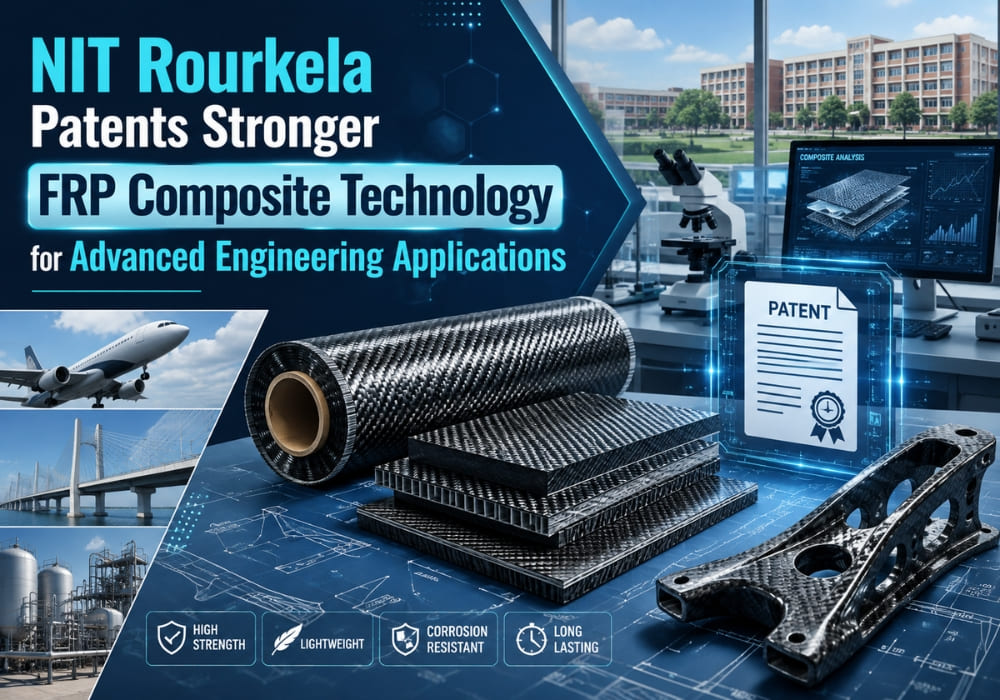
Author – Ritesh Ranjan: Researchers at the National Institute of Technology Rourkela have secured a patent for an advanced Fiber-Reinforced Polymer composite manufacturing technology designed to deliver greater strength, toughness and durability.
The innovation, protected under Patent No. 596943, introduces a three-dimensional reinforced composite made using glass fibres, graphene nanoplatelets and an epoxy matrix. The technology could benefit industries that require lightweight materials capable of operating under high mechanical pressure and demanding environmental conditions.
Developed by the FRP Composite Lab of NIT Rourkela’s Department of Metallurgical and Materials Engineering in collaboration with MNIT Jaipur, the patented material demonstrates substantial improvements in tensile strength, flexural performance, fracture toughness and resistance to internal damage.
Why FRP Composites Are Important
Fiber-Reinforced Polymer composites are widely used in industries where manufacturers need to reduce structural weight without compromising strength.
Compared with many conventional materials, FRP composites offer a high strength-to-weight ratio, corrosion resistance, design flexibility and relatively low maintenance requirements. These properties have made them important in commercial aircraft, defence equipment, space launch vehicles, high-speed railway systems, wind turbines, marine structures and hydrogen storage tanks.
However, conventional FRP composites are not completely immune to damage. Under repeated loading, pressure or impact, cracks may form within the material. Different layers of the composite can also begin to separate, a process known as delamination.
Such internal damage may not always be immediately visible from the surface. Over time, it can reduce structural performance, increase maintenance requirements and raise the risk of component failure.
The patented technology from NIT Rourkela aims to address these limitations by strengthening the internal structure of the composite.
A Three-Dimensional Reinforced Composite Design
The new technology combines glass fibre-reinforced epoxy with graphene nanoplatelets aligned through the thickness of the material.
In conventional laminated composites, reinforcement is often concentrated mainly along the length and width of the structure. Although this arrangement provides excellent in-plane strength, the material may remain comparatively vulnerable in the through-thickness direction.
The NIT Rourkela-led research team has developed a three-dimensional reinforcement approach in which graphene nanoplatelets help strengthen this weaker direction.
By aligning graphene through the thickness of the composite, the fibres, nanoplatelets and epoxy matrix can interact more effectively. This creates a stronger internal network that improves load transfer and helps prevent cracks from growing between layers.
The improved structure makes the composite tougher, more resistant to delamination and better suited to demanding engineering applications.
Simple Manufacturing Process Supports Industrial Adoption
One of the most important features of the patented technology is the relative simplicity of its manufacturing process.
The researchers aligned unmodified graphene nanoplatelets in glass fibre-reinforced epoxy composites using a standard 50 Hz alternating-current electric field at 800 volts during the curing process.
The ability to use unmodified graphene is significant because complex chemical treatments can increase manufacturing time, cost and process requirements.
The electric-field alignment method may also be introduced into existing composite manufacturing systems with comparatively minor modifications. This could make the technology more practical for commercial manufacturers seeking to improve material performance without completely redesigning their production infrastructure.
A technology that performs well in the laboratory but requires highly specialised equipment may face difficulties during industrial adoption. By focusing on manufacturing simplicity, the researchers have improved the possibility of scaling the innovation for larger components.
Strong Performance in Laboratory Testing
The patented composite was evaluated through laboratory-scale testing conducted according to ASTM standards. The results showed improvements across several important mechanical and performance indicators.
The composite recorded:
- A 37% increase in tensile strength
- A 30% improvement in flexural strength
- A 63% increase in flexural modulus
- A 26% improvement in tensile modulus
- A 24% improvement in interlaminar shear strength
- A 33% increase in Mode-I fracture toughness
- A 53% increase in Mode-II fracture toughness
- A 55% higher storage modulus at 40°C
These results indicate that the material is not only stronger but also more resistant to bending, cracking, layer separation and deformation.
Higher tensile strength means the composite can withstand greater pulling forces before failure. Improved flexural strength and modulus indicate better performance when the material is subjected to bending loads.
The increase in interlaminar shear strength is particularly important because it reflects greater resistance to separation between composite layers.
Mode-I fracture toughness measures resistance to crack opening, while Mode-II fracture toughness evaluates resistance to cracks caused by sliding or shearing movement. Improvements in both categories suggest that the material could offer better damage tolerance under complex loading conditions.
The higher storage modulus at 40°C also indicates better stiffness and elastic performance at elevated temperatures.
Potential Applications Across High-End Industries
According to the research team, the technology could be used in a wide range of advanced engineering structures.
Possible applications include aircraft panels, automotive crash-resistant structures, wind turbine blades, pressure vessels, marine components and lightweight structural systems.
In the aerospace industry, stronger composites could help manufacturers reduce aircraft weight while maintaining safety and structural integrity. Lower weight can contribute to improved fuel efficiency and reduced operating emissions.
In the automotive sector, the technology may support lightweight crash structures capable of absorbing mechanical energy while improving vehicle efficiency.
Wind turbine blades could also benefit from greater resistance to cracking, fatigue and environmental stress. Since turbine blades are continuously exposed to wind loads and changing weather conditions, improved durability could reduce maintenance needs and extend their operational life.
Pressure vessels and hydrogen storage tanks require materials that can withstand repeated pressure cycles without developing serious internal damage. Improved fracture toughness and interlaminar strength could therefore make the patented composite relevant to clean-energy infrastructure.
Marine structures may benefit from the composite’s corrosion resistance, reduced weight and improved mechanical performance.
Supporting Sustainability and Lower Maintenance Costs
The technology may also contribute to more sustainable manufacturing.
Lightweight materials can reduce the energy required to operate aircraft, vehicles and other transport systems. Longer-lasting components can also reduce the frequency of replacement, lowering material consumption and industrial waste.
Prof. Bankim Chandra Ray highlighted the potential of the innovation to reduce maintenance costs, improve energy efficiency and support sustainable engineering.
For industries operating expensive equipment, even a modest increase in component life can produce meaningful financial benefits. More durable materials may reduce downtime, inspection requirements and repair expenses.
The combination of strength, lightweight construction and longer service life makes advanced composites strategically important for industries seeking both economic and environmental improvements.
Collaboration Behind the Innovation
The patented technology was developed through a collaboration between NIT Rourkela and MNIT Jaipur.
The research team includes Dr. Rajesh Kumar Prusty, Prof. Bankim Chandra Ray, Mr. Parimal Jana and Dr. Dinesh Kumar Rathore.
Such institutional collaborations are important for advancing materials research because they bring together specialised expertise, laboratory infrastructure and different technical perspectives.
The patent also demonstrates how academic research can be converted into technologies with potential industrial value.
What Comes Next?
The researchers plan to evaluate the composite in larger structural components and study its long-term durability under different environmental conditions.
While laboratory results are promising, large-scale testing will be essential to determine how the material performs under real-world operating conditions. Factors such as moisture, temperature changes, repeated loading, chemical exposure and long-term ageing may influence its commercial suitability.
The team is also exploring technology licensing and collaboration with industry partners. These partnerships could support prototype development, manufacturing trials and the eventual commercialisation of the technology.
A Step Forward for India’s Advanced Materials Ecosystem
The patented FRP composite technology represents an important development in India’s advanced materials research landscape.
By improving the internal strength and damage resistance of lightweight composites through a relatively adaptable manufacturing process, the innovation has the potential to support sectors such as aerospace, automotive engineering, renewable energy, defence and hydrogen storage.
It also reflects the role of academic institutions in developing high-value technologies aligned with the goals of Atmanirbhar Bharat.
Successful industrial adoption will depend on further testing, scaling and collaboration. Nevertheless, Patent No. 596943 marks a promising step towards stronger, more durable and more sustainable composite structures for advanced engineering applications.
Frequently Asked Questions
1. What has NIT Rourkela patented?
NIT Rourkela researchers have patented a manufacturing technology for a three-dimensional Fiber-Reinforced Polymer composite. The material combines glass fibres, graphene nanoplatelets and an epoxy matrix to improve strength, stiffness, toughness and resistance to internal damage.
2. What is the patent number of the FRP composite technology?
The technology has been secured under Patent No. 596943.
3. How does graphene improve the FRP composite?
Graphene nanoplatelets are aligned through the thickness of the composite using an alternating-current electric field. This improves interaction between the fibres, graphene and epoxy matrix, resulting in better load transfer, crack resistance and interlaminar strength.
4. Which industries could use this patented composite?
The composite could potentially be used in aerospace panels, automotive crash structures, wind turbine blades, pressure vessels, hydrogen storage tanks, marine structures, defence equipment and other high-performance engineering applications.
5. What are the next steps for the researchers?
The research team plans to conduct larger structural trials, assess long-term environmental durability and explore technology licensing and industry collaborations for commercial deployment.