

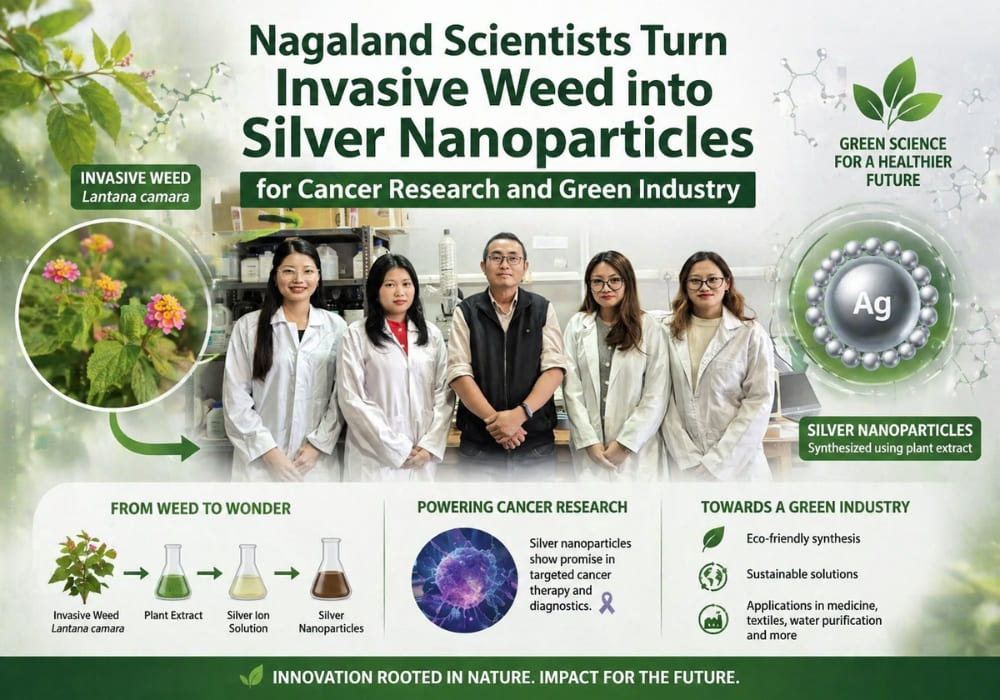
Author – Ritesh Ranjan: In a remarkable scientific breakthrough, researchers from Nagaland University and Fazl Ali College have transformed one of the region’s most destructive invasive weeds into a valuable resource for medicine, cancer research and green industrial manufacturing.
The weed, Mikania micrantha, has long been considered a major ecological threat in Nagaland and across many tropical regions. Known for its rapid growth and ability to smother native vegetation, the plant has caused environmental and agricultural challenges for years. However, scientists have now found a way to convert this problem into an opportunity by using its leaf extracts to create eco-friendly silver nanoparticles.
This development highlights how local biodiversity, when combined with modern research, can generate globally significant innovations in healthcare and sustainable technology.
What Makes This Discovery Important?
Traditional nanoparticle production often depends on toxic chemicals, expensive industrial processes, and high-energy manufacturing methods. These conventional techniques can be harmful to both human health and the environment.
The Nagaland research team used a completely different approach based on green chemistry. Instead of hazardous reagents, they used natural leaf extracts from Mikania micrantha to synthesize stable silver nanoparticles in an environmentally friendly way.
This means the process is:
- Cleaner
- Safer
- Cost-effective
- Sustainable
- Easier to scale for industries
By replacing synthetic chemicals with plant-based materials, the researchers have demonstrated how nature can support advanced scientific manufacturing.
From Weed to High-Value Medical Resource
The biggest surprise in this research is that an invasive weed, often viewed as useless or harmful, can now contribute to modern medicine.
The silver nanoparticles created from Mikania micrantha showed excellent performance in producing important pharmaceutical compounds called imidazoles. These compounds are widely used in medicines, antifungal drugs, anti-inflammatory treatments, and other healthcare products.
Even more impressive, the nanoparticles accelerated the production process dramatically, completing reactions in just 30 to 180 seconds.
This rapid synthesis could significantly reduce manufacturing time in pharmaceutical plants, helping companies lower costs while increasing efficiency.
Reusable Nanoparticles for Sustainable Industry
One of the strongest advantages of this innovation is reusability.
The nanoparticles can be reused at least six times with very little drop in efficiency. In industrial manufacturing, reusable catalysts are highly valuable because they reduce:
- Raw material costs
- Production waste
- Chemical disposal issues
- Energy consumption
This makes the technology especially attractive for large-scale drug production and green industrial operations.
Exceptional Heat Stability
Another key feature of these nanoparticles is their durability.
The particles are naturally coated with plant-derived compounds, giving them strong thermal stability even at temperatures up to 165°C. This is important because many pharmaceutical and industrial reactions require high-temperature conditions.
Stable nanoparticles can perform consistently under stress, making them suitable for real-world commercial use.
Powerful Antibacterial Applications
The silver nanoparticles also displayed strong antibacterial properties against dangerous pathogens, including:
- Staphylococcus aureus infection causing bacteria (Staphylococcus aureus)
- Plague causing bacteria (Yersinia pestis)
This suggests the nanoparticles may be useful in developing:
- Antimicrobial hospital coatings
- Wound dressings
- Medical devices
- Infection prevention systems
- Hygiene and sanitation products
As antibiotic resistance continues to rise worldwide, alternative antibacterial solutions like silver nanoparticles are becoming increasingly valuable.
Hope for Future Cancer Treatments
Perhaps the most exciting part of the study is its anticancer potential.
Researchers tested the nanoparticles on human colon cancer cells and found they significantly reduced cell viability. In fact, the nanoparticles were nearly twice as potent as the raw plant extract alone.
This indicates that nanoparticle-enhanced plant compounds may offer a more effective route for cancer therapy in the future.
While more studies and clinical trials are needed, these findings open promising possibilities for:
- Targeted cancer treatments
- Reduced side effects therapies
- Plant-based nanomedicine
- Affordable cancer care solutions
Why This Matters Beyond Nagaland
This breakthrough is not just a regional success story—it reflects a global model for sustainable innovation.
Many countries struggle with invasive plant species that damage ecosystems and cost millions in control efforts. Instead of only removing them, scientists can now explore ways to convert such plants into valuable industrial resources.
For biodiverse regions like Northeast India and the Eastern Himalayas, this could unlock new opportunities in:
- Biotechnology
- Pharmaceutical manufacturing
- Rural economies
- Green startups
- Sustainable exports
Nagaland’s research demonstrates that world-class scientific innovation can emerge from local environmental challenges.
The Role of Research Institutions
The study was supported by the Anusandhan National Research Foundation and the National Fellowship for Scheduled Tribe Students, proving how institutional funding can drive transformative research.
The findings were published in Biochemical and Biophysical Research Communications, an internationally respected journal known for high-impact discoveries in life sciences.
This gives the research strong scientific credibility and wider international visibility.
A New Future for Green Chemistry in India
India has immense biodiversity, and many native or invasive plants remain scientifically unexplored. This research serves as a blueprint for how universities and research centers can identify hidden value in local flora.
By turning an ecological threat into a solution for healthcare and industry, Nagaland scientists have shown that sustainability and innovation can go hand in hand.
The next breakthrough in medicine may not come only from synthetic chemicals or billion-dollar labs—it may come from the plants growing unnoticed in our own landscapes.
FAQs
1. What is Mikania micrantha?
Mikania micrantha is a fast-growing invasive weed that spreads aggressively and harms native plants and ecosystems.
2. How did Nagaland scientists use this weed?
Researchers used extracts from its leaves to produce eco-friendly silver nanoparticles for medical and industrial applications.
3. What are silver nanoparticles used for?
Silver nanoparticles are used in antibacterial products, drug manufacturing, cancer research, coatings, and biomedical technologies.
4. Can these nanoparticles help in cancer treatment?
Early lab tests showed promising anticancer effects on colon cancer cells, but more research is needed before medical use.
5. Why is this discovery important?
It turns an environmental problem into a valuable solution for healthcare, pharmaceuticals, and green manufacturing.