

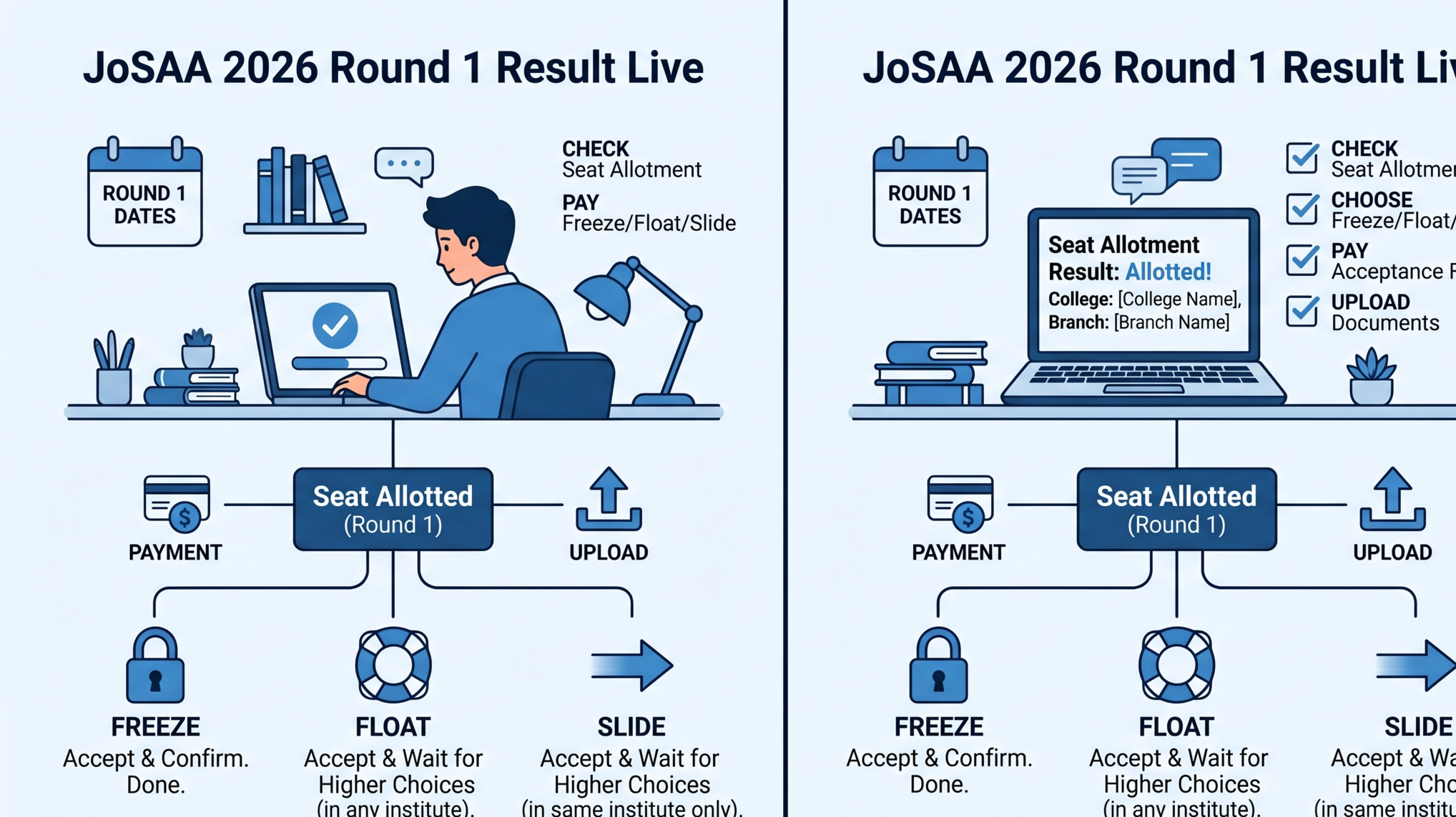
If you appeared for JEE Main or JEE Advanced 2026 and have been refreshing josaa.nic.in every few minutes, the wait is finally over. The Joint Seat Allocation Authority has released the JoSAA 2026 seat allotment result for round 1 on June 13 on the official website josaa.nic.in. This is the moment that decides which IIT, NIT, IIIT, or GFTI you’re one step closer to joining.
In this guide, you’ll learn exactly how to check your JoSAA 2026 Round 1 result, what the Freeze, Float, and Slide options actually mean for your future, how to read opening and closing ranks, the full counselling timeline, and the most common mistakes students make right after allotment — mistakes that can cost them a seat entirely.
Table of Contents
- What Is JoSAA 2026 Round 1 Result?
- How to Check Your Allotment Status
- Understanding Opening and Closing Ranks
- Freeze, Float, or Slide — What Should You Choose?
- JoSAA 2026 Important Dates
- Documents Required for Reporting
- Eligibility Recap
- Tips and Best Practices
- Common Mistakes to Avoid
- Latest Trends and Updates
- Key Takeaways
- FAQs
What Is JoSAA 2026 Round 1 Result?
JoSAA (Joint Seat Allocation Authority) coordinates admissions to 23 IITs, IISc Bengaluru, NITs, IIITs, IIEST Shibpur, and other GFTIs based on JEE Main and JEE Advanced ranks. JoSAA announces the JoSAA 2026 counselling round-wise seat allotment result under the respective JoSAA login of the candidates.
After the release of Mock Allotment results, Joint Seat Allocation Authority published the Round 1 Seat Allocation result on June 13, 2026. This was preceded by mock rounds that helped candidates fine-tune their choices — the Mock Allotment Round 1 Result was released on June 8, 2026, giving students a few days to rearrange preferences before the final lock.
If a seat has been allotted to you, here’s what happens next:
- You must download the “Initial Seat Allotment Intimation Slip,” which carries details about the allotted seat.
- It is entirely your responsibility to log in and check your status — no separate intimation will be sent to you.
- You then choose between Freeze, Float, or Slide and proceed with document upload and fee payment.
How to Check Your Allotment Status
Checking your result takes less than five minutes if you have your credentials ready. Here’s the step-by-step process:
- Go to the official website: josaa.nic.in
- Click on the link marked “Allotment Result 1” on the home page
- Log in using your JEE Main 2026 roll number and password
- Click the link to check the seat allotted to you as per your choices
- Download and save the Provisional Seat Allotment Letter for your records
Pro tip: Don’t rely on mobile data alone during peak hours (10 AM–12 PM on result day). The portal gets heavy traffic, so try early morning or late evening if it’s slow, and always save a PDF copy of your allotment letter immediately — screenshots aren’t accepted for verification.
Understanding Opening and Closing Ranks
This is where most first-time candidates get confused, so let’s break it down simply.
- Opening Rank — the best (lowest) rank at which a candidate was admitted to a specific institute, branch, and category combination in a particular round. In Round 1, this is typically AIR 1 for highly competitive programs like IIT Bombay CSE.
- Closing Rank — the last (highest) rank at which a seat was allotted for that institute-branch-category combination. This is your cutoff — if your rank is equal to or better than the closing rank, you’re eligible.
Why Round 1 ranks aren’t the final word
Always refer to the final round closing rank — Round 5 for IITs, Round 5 or 6 for NITs — rather than Round 1, for accurate admission planning, since closing ranks typically relax (increase) in later rounds.
However, this relaxation isn’t uniform. Top IIT CSE seats barely move between rounds — IIT Bombay CSE closed at rank 66 in Round 1 and remained at 66 in Round 6 in 2025. There’s no meaningful round-wise relaxation for elite seats. On the other hand, Round 6 for NITs consistently shows the widest closing rank gap compared to Round 1.
What this means practically: If you’re aiming for IIT Bombay/Delhi CSE, your Round 1 rank is essentially your final shot. But if you’re targeting a mid-tier NIT branch, don’t panic if you don’t get it in Round 1 — there’s a real chance it opens up by Round 4 or 5.
Real-world example
Say your JEE Main rank is 8,500 (General category) and you’re eyeing NIT Trichy’s Electrical Engineering. If the 2025 Round 1 closing rank for that combination was around 7,200, you likely won’t get it in Round 1 — but if the Round 5 closing rank moved to 9,000 (a realistic relaxation pattern for mid-tier NIT branches), Floating instead of Freezing your current allotment could pay off.
JoSAA cutoff is released after each seat allocation round, and it can change after every round — for IITs it’s based on JEE Advanced ranks, while for NITs, IIITs, IIEST Shibpur, and other GFTIs it’s based on JEE Main ranks.
Freeze, Float, or Slide — What Should You Choose?
After seeing your Round 1 result, JoSAA gives you three options. Choosing the right one is arguably more important than the result itself.
Freeze
Accept the allotted seat and exit further rounds. Choose this if you’re genuinely happy with the institute and branch — because if you opt for Freeze, the option cannot be changed in subsequent rounds under any circumstances.
Float
Accept the seat but remain eligible for a better option in future rounds. This is the most flexible option — you keep your current seat as a safety net while staying in the running for upgrades across any institute or branch.
Slide
Accept the seat while seeking a better course within the same institute. Choose this if you like the institute (say, NIT Surathkal) but want to try for a better branch within it.
Practical advice: If you got your dream combination, Freeze without hesitation. If you got an institute you like but a branch you’re unsure about, Slide. If both feel like a compromise, Float — but only if you’re genuinely fine with your current allotment as a fallback, since candidates who Float or Slide in earlier rounds free up lower-preference seats, allowing candidates with slightly lower ranks to receive upgrades — meaning your current seat could get passed on if you move up.
JoSAA 2026 Important Dates
Here’s the confirmed schedule based on the latest official updates:
| Event | Date |
|---|---|
| Registration & Choice Filling Begins | June 2, 2026 |
| Mock Allotment 1 | June 8, 2026 |
| Choice Filling Closes | June 11, 2026, 5:00 PM IST |
| Round 1 Seat Allotment Result | June 13, 2026 |
| Online Reporting/Fee Payment/Document Upload (Round 1) | June 13 to 26, 2026, till 17:00 IST |
| Round 2 Seat Allotment Result | June 30, 2026 |
| Round 2 Admission Confirmation | June 30 to July 3, 2026 |
This year, there will be five rounds of JoSAA counselling in total. Each round follows the same cycle: allotment, reporting/fee payment, and document verification.
Documents Required for Reporting
After Round 1 allotment, regardless of which option you choose, you’ll need to upload:
- JEE Main / JEE Advanced 2026 Admit Card and Scorecard
- Class 10 and 12 marksheets and certificates
- Category certificate (SC/ST/OBC-NCL/EWS), if applicable
- PwD certificate, if applicable
- Provisional Seat Allotment Letter (downloaded from portal)
- Passport-size photograph and signature (as per portal specifications)
- Seat acceptance fee receipt
After document verification, JoSAA issues a Provisional Seat Allotment Letter, which remains provisional until all counselling fees are settled. Since this letter is mandatory for physical reporting, candidates must save a digital copy and print multiple physical versions.
Eligibility Recap
A quick refresher in case you’re counselling on behalf of a sibling or friend too:
- For IITs and IISc: Must have qualified JEE Advanced 2026 with a valid rank.
- For NITs, IIITs, IIEST, and other GFTIs: Must have a valid JEE Main 2026 CRL (Common Rank List) rank.
- Candidates must have completed online registration and choice-filling within the deadline.
- Domicile certificates are not required for IIT, NIT, or IIIT admission through JEE — the state where you took your 12th board exam determines Home State Quota eligibility for NITs, not your home state.
Tips and Best Practices
- Check your result the moment it’s live — don’t wait till evening, since reporting deadlines are tight and document issues take time to resolve.
- Read your allotment letter carefully — verify your name, category, rank, and allotted program for any data entry errors before proceeding.
- Use previous year cutoffs as a guide, not a guarantee. Previous year cutoff should not be treated as a guarantee for the current year, but studying cutoff trends across three years — 2023, 2024, and 2025 — is the most reliable method to set a safe target rank.
- Keep scanned documents ready in advance — PDF format, correct file size, properly labeled.
- Track your category-wise cutoff separately for Home State and Other State quota at NITs, since these differ significantly.
Common Mistakes to Avoid
- Freezing too early out of fear. Many students Freeze a decent-but-not-ideal seat in Round 1 simply because they’re nervous, then regret it when better options open up in Round 3 or 4.
- Ignoring the reporting deadline. Missing the fee payment window can cancel your allotment entirely — JoSAA does not send reminder calls.
- Uploading blurry or wrong documents. This leads to “query raised” status, which delays your admission process.
- Assuming Float guarantees an upgrade. Floating only keeps you in the running; it doesn’t guarantee movement, and in rare cases you could end up with no seat if your current allotment is taken by someone else and you don’t get a new one — though JoSAA’s rules generally protect against a total loss in most cases.
- Not checking category-specific closing ranks. General category cutoffs are often shared widely, but reserved category candidates must check their specific category column, which can differ drastically.
Latest Trends and Updates
- This year, there will be five rounds in JoSAA counselling, consistent with recent cycles, though 2025 had six rounds — always verify the current year’s schedule on the portal.
- JoSAA 2026 cutoff PDFs will provide opening and closing rank details across 138 participating institutes, including 23 IITs, IISc Bengaluru, and 31 NITs.
- Counselling timelines have been compressing slightly year-over-year as JEE Advanced results get processed faster — Round 1 in 2026 arrived close to the JEE Advanced result, similar to the pattern in 2025.
- Students are increasingly using rank-prediction and seat-probability tools before locking choices, reflecting a shift toward data-driven decision making in counselling.
Key Takeaways
- JoSAA 2026 Round 1 result is live — check it immediately at josaa.nic.in using your JEE login.
- Download your Provisional Seat Allotment Letter the moment it’s available.
- Choose Freeze, Float, or Slide carefully — Freeze is permanent, Float and Slide keep you in the running.
- Complete reporting and fee payment well before the June 26 deadline to avoid losing your seat.
- Use 3-year historical opening/closing rank trends to set realistic expectations for later rounds.
Conclusion
JoSAA Round 1 is just the opening move in a five-round process — not the final verdict. Whether you’ve landed your dream IIT branch or you’re still aiming higher, understanding how opening and closing ranks shift across rounds, and making an informed Freeze/Float/Slide decision, will shape your engineering journey for the next four years. Stay alert for deadlines, keep your documents ready, and track each round’s results carefully on josaa.nic.in.
FAQs
1. When was the JoSAA 2026 Round 1 result released?
The JoSAA Round 1 Seat Allotment Result 2026 was released on June 13 at 10:00 AM on josaa.nic.in.
2. How do I check my JoSAA 2026 Round 1 allotment status?
Visit josaa.nic.in, click “Allotment Result 1,” and log in using your JEE Main 2026 roll number and password to view your allotted institute and program.
3. What’s the difference between Freeze, Float, and Slide?
Freeze accepts your seat and exits further rounds; Float accepts the seat but keeps you eligible for upgrades; Slide accepts the seat while seeking a better branch within the same institute.
4. Can I change my Freeze decision later?
No. Once you opt for Freeze, it cannot be changed in subsequent rounds under any circumstances.
5. When is JoSAA Round 2 result coming out?
JoSAA Round 2 seat allotment result will be released on June 30, 2026.
6. Is a domicile certificate needed for NIT admission via JoSAA?
No. Domicile certificates aren’t required; the state where you took your 12th board exam determines Home State Quota eligibility.
7. How many total rounds does JoSAA 2026 counselling have?
JoSAA 2026 counselling will be conducted in five rounds.
Next article
NSUT Admission 2026 guide eligibility, JEE Main entrance details, JAC Delhi counselling dates, selection process, cutoffs & documents