

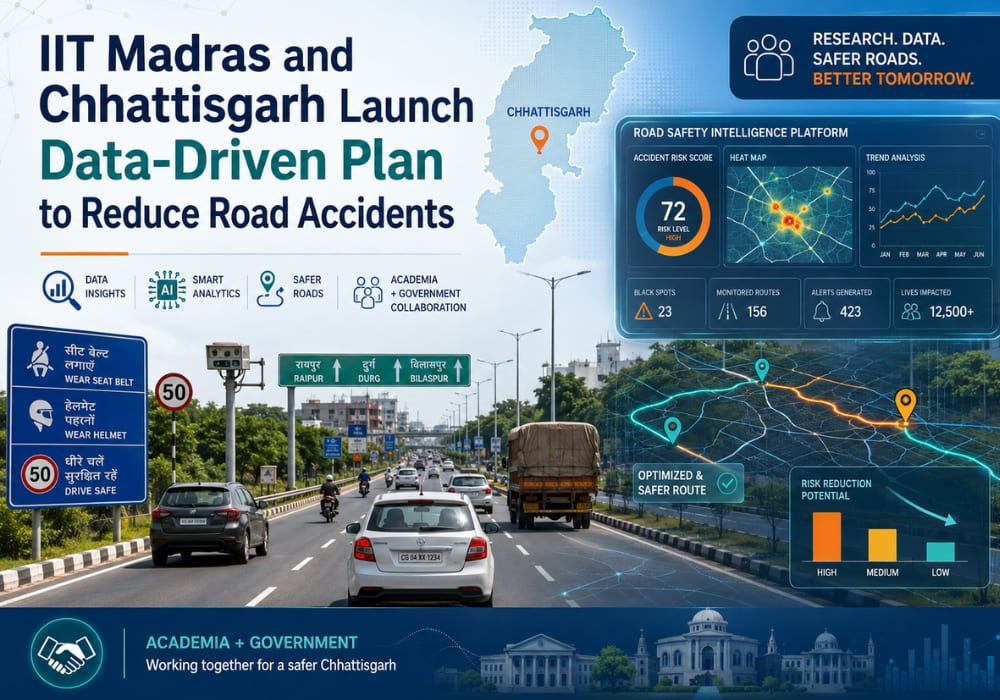
Author – Ritesh Ranjan: Road accidents remain one of India’s most serious public safety challenges, causing irreversible loss to families and communities every year. Addressing this issue requires more than general awareness campaigns. It demands accurate data, district-level planning, improved road engineering and faster intervention at locations where accidents occur frequently.
Taking a major step in this direction, the Indian Institute of Technology Madras has partnered with the Government of Chhattisgarh to launch the Data-Driven Hyperlocal Interventions programme across the state.
The initiative, led by IIT Madras’ Centre of Excellence for Road Safety, will use local road accident data, technical assessments, training and low-cost engineering solutions to improve road safety in nine priority districts of Chhattisgarh.
MoU Signed Between IIT Madras and Chhattisgarh Government
A Memorandum of Understanding was signed in Raipur on 23 July 2026 by Prof. Venkatesh Balasubramanian, Head of the Centre of Excellence for Road Safety at IIT Madras, and Shri S. Prakash, Secretary and Commissioner of the Transport Department, Government of Chhattisgarh.
Through this partnership, IIT Madras will support the state government in developing district-specific road safety strategies. The programme will pay particular attention to tribal and mining-dominated regions, where road conditions, traffic movement, vehicle types and local mobility requirements can differ significantly from those in large cities.
The collaboration aims to reduce road crashes through scientific planning, timely intervention and stronger coordination between state departments, district authorities, engineers, enforcement agencies and local communities.
What Is the DDHI Programme?
The Data-Driven Hyperlocal Interventions programme, commonly known as DDHI, is based on the idea that road safety solutions should be designed according to local conditions.
Instead of implementing the same road safety measures everywhere, the programme studies recorded accident data as well as risks perceived by officials and local communities. This information is used to identify accident patterns, dangerous road stretches, black spots and emerging risk locations.
Authorities can then introduce targeted solutions based on the specific problem identified in each area.
For example, a dangerous junction may require improved signs, road markings or traffic-calming measures. A mining route may need better management of heavy vehicles, while a tribal region may require interventions based on its terrain, pedestrian movement and limited enforcement resources.
This hyperlocal approach makes road safety planning more practical and effective.
Nine Priority Districts Selected
The first phase of the DDHI programme in Chhattisgarh will cover nine priority districts:
- Raipur
- Raigarh
- Surajpur
- Balod
- Baloda Bazar
- Jashpur
- Surguja
- Mahasamund
- Jangir
These districts will receive technical assistance from the Centre of Excellence for Road Safety. The support will include road safety assessments, engineering recommendations, administrative interventions, training programmes and capacity building for district and state officials.
By strengthening local capabilities, the programme will enable district authorities to identify risks, make informed decisions and respond more quickly to dangerous road conditions.
IIT Madras is already working with 17 state governments under the DDHI framework. Chhattisgarh has now joined this growing national effort to improve road safety through data, technology and locally designed interventions.
Why Hyperlocal Road Safety Planning Matters
Road safety challenges are not identical across districts. Urban areas may experience congestion, speeding, unsafe junctions and high pedestrian movement. Rural regions may face poor lighting, limited signage, narrow roads and delayed emergency response.
Mining areas may have a large number of heavy commercial vehicles, while tribal regions may have unique geographical and mobility challenges.
A single statewide policy may not fully address these differences. Hyperlocal planning allows officials to study the conditions in each district and introduce interventions that respond directly to local risks.
The DDHI programme also focuses on low-cost, high-impact measures. This is particularly important because district officials may be able to implement many of these solutions without waiting for lengthy approvals or major infrastructure budgets.
Faster decision-making can help authorities address dangerous locations before more crashes occur.
Sanjaya Platform to Support Evidence-Based Action
A major component of the programme is the use of the Sanjaya platform developed by the Centre of Excellence for Road Safety.
The platform helps authorities identify existing accident black spots as well as emerging crash locations. This allows officials to take evidence-based action before a location develops into a more serious accident zone.
Shri S. Prakash highlighted the importance of the platform in supporting timely interventions. He also emphasised that the partnership is not intended to be limited to a one-day event or awareness programme.
Instead, the initiative will involve long-term implementation, regular monitoring, technical support and continuous improvement across the selected districts.
The use of data can also help departments evaluate whether an intervention is working. Officials can compare accident patterns before and after changes are introduced and make further adjustments where necessary.
Road Safety as a Shared Responsibility
Shri Kedar Kashyap, Hon’ble Minister of Transport, Government of Chhattisgarh, underlined the human impact of road accidents. He stated that every accident causes an irreparable loss to families and stressed the importance of creating a road system in which every citizen can return home safely.
He also described road safety as a shared responsibility involving the government, administration, engineers, local bodies and citizens.
This shared-responsibility approach is central to the DDHI programme. Engineering improvements alone may not be enough without effective enforcement, responsible driving, public awareness and cooperation from local communities.
By bringing different stakeholders together, the programme aims to create a coordinated road safety system rather than relying on isolated measures.
IIT Madras’ Role in Building Safer Roads
Prof. V. Kamakoti, Director of IIT Madras, said the programme demonstrates how academic institutions and governments can work together to address complex social challenges.
IIT Madras will contribute technical expertise, research capabilities, data analysis and training support to the partnership.
Prof. Venkatesh Balasubramanian noted that road safety in tribal and mining regions must be shaped by factors such as terrain, vehicle composition, enforcement capacity and community behaviour.
This means that successful interventions must reflect how people actually use roads in each district instead of depending only on standardised assumptions.
Supporting India’s 2030 Road Safety Goal
The IIT Madras–Chhattisgarh partnership supports the Government of India’s goal of reducing road accident deaths by 50 per cent by 2030.
Achieving this target will require coordinated action at the national, state and district levels. Better data collection, safer road design, stronger enforcement, trained officials and community participation will all play an important role.
The DDHI programme offers a practical model by combining scientific analysis with local implementation. Its emphasis on low-cost solutions could also help districts make meaningful improvements without depending entirely on large infrastructure projects.
As the programme expands across the nine selected districts, its results could provide valuable lessons for other states facing similar road safety challenges.
With accurate data, trained officials and faster local action, the partnership has the potential to prevent accidents, save lives and create safer roads across Chhattisgarh.
Frequently Asked Questions
1. What is the DDHI programme?
The Data-Driven Hyperlocal Interventions programme is a road safety initiative developed by IIT Madras’ Centre of Excellence for Road Safety. It uses local accident data, technical assessments and district-specific solutions to identify dangerous roads and reduce crashes.
2. Which districts are included in the first phase?
The first phase will cover Raipur, Raigarh, Surajpur, Balod, Baloda Bazar, Jashpur, Surguja, Mahasamund and Jangir.
3. What support will IIT Madras provide?
IIT Madras will provide road safety assessments, engineering recommendations, administrative support, data analysis, training and capacity-building programmes for state and district officials.
4. What is the Sanjaya platform?
Sanjaya is a platform developed by the Centre of Excellence for Road Safety. It helps officials identify accident black spots and emerging crash locations so that evidence-based interventions can be implemented quickly.
5. How will the programme help reduce road accidents?
The programme will identify district-level risks and recommend targeted, low-cost interventions such as improved signs, road markings, junction redesign, traffic-calming measures, enforcement improvements and administrative action.