

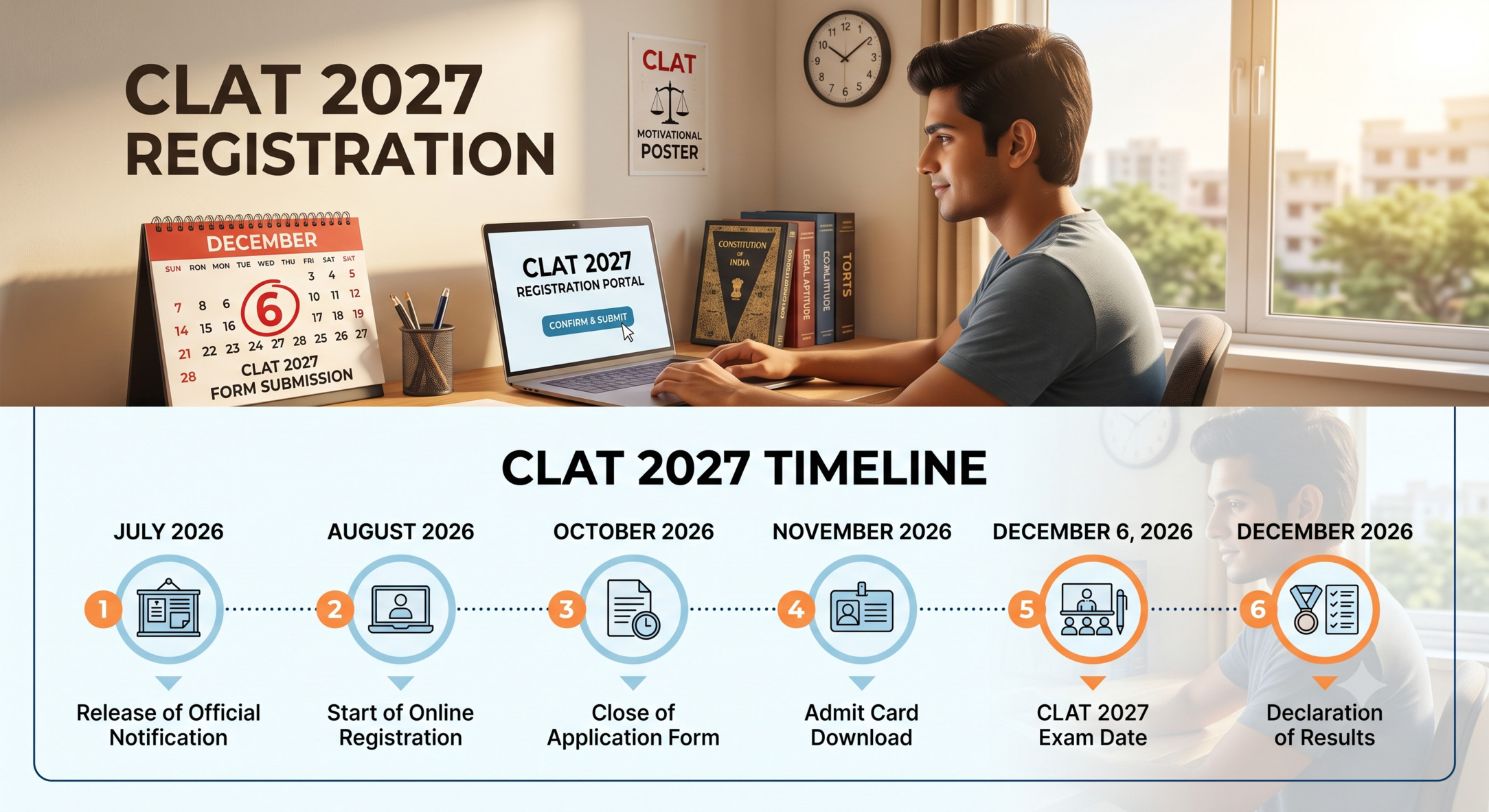
If you’ve been refreshing consortiumofnlus.ac.in every few days waiting for an update, you can stop now. The Consortium of National Law Universities has officially opened CLAT 2027 registration, and the exam date, fee structure, and eligibility rules are all confirmed. Roughly 60,000 students compete for around 3,200–3,500 seats across the National Law Universities every year, so getting your paperwork and prep timeline right from day one genuinely matters.
In this guide, you’ll learn exactly when to register, who’s eligible for UG and PG CLAT, how much the form costs, what’s changed (and what hasn’t) in the exam pattern, and a realistic month-by-month preparation roadmap — the kind of practical detail you won’t find in a generic notification PDF.
Table of Contents
- CLAT 2027: Quick Overview
- Important Dates You Cannot Miss
- Eligibility Criteria (UG and PG)
- Step-by-Step Registration Process
- Application Fee Details
- Exam Pattern and Syllabus
- Why CLAT Matters: Benefits of Cracking It
- Preparation Strategy: A Realistic Roadmap
- Common Mistakes Applicants Make
- Latest Updates and Trends for CLAT 2027
- Key Takeaways
- Conclusion
- FAQs
CLAT 2027: Quick Overview
The Common Law Admission Test (CLAT) is the single gateway exam for admission into 5-year integrated undergraduate law programmes (like BA LLB, BBA LLB, BCom LLB) and one-year LLM programmes at 27 National Law Universities across India. Several private law schools also accept CLAT scores, so one exam opens a lot of doors.
Here’s the snapshot:
- Conducting body: Consortium of National Law Universities (NLUs)
- Notification released: July 22, 2026
- Exam date: Sunday, December 6, 2026
- Exam timing: 2:00 PM to 4:00 PM (extended to 4:40 PM for PwD candidates)
- Mode: Offline, pen-and-paper (OMR-based)
- Official website: consortiumofnlus.ac.in
Unlike many entrance exams that have shifted to computer-based testing, CLAT has stuck with the offline OMR format for years now, and there’s no indication that’s changing for 2027.
Important Dates You Cannot Miss
Mark these on your calendar — CLAT doesn’t usually offer generous extensions, though it has happened before (CLAT 2026’s deadline was pushed from October 31 to November 7 after student demand).
| Event | Date |
|---|---|
| Official notification released | July 22, 2026 |
| Registration opens | August 3, 2026 |
| Last date to register | October 31, 2026 |
| Admit card release (expected) | Last week of November 2026 |
| CLAT 2027 exam | December 6, 2026 |
| Provisional answer key | Within a few days of the exam |
| Result declaration (expected) | Third week of December 2026 |
| Counselling begins (expected) | Last week of December 2026 |
A quick, honest note: dates after the exam (admit card, result, counselling) are based on the Consortium’s usual pattern from previous years and could shift slightly. The registration window and exam date, however, are officially confirmed.
Eligibility Criteria (UG and PG)
CLAT eligibility is different depending on whether you’re applying for the undergraduate or postgraduate route. There’s no upper age limit for either.
CLAT UG 2027 Eligibility
- Passed or appearing in Class 12 (or equivalent) from a recognized board
- Minimum 45% marks required (40% for SC/ST and PwD candidates)
- Students appearing for their board exams in 2027 can apply provisionally, but must submit proof of passing during counselling
CLAT PG 2027 Eligibility
- An LLB degree or equivalent qualification
- Minimum 50% marks (45% for SC/ST/PwD candidates)
- Final-year LLB students can also apply, subject to producing their degree at counselling
Practical tip: If you’re in the “appearing” category for either exam, don’t wait for your results to register. The Consortium allows provisional registration precisely so students don’t miss the window — just make sure you have your marksheets ready before the counselling rounds start.
Registration Process
Here’s exactly how to fill the CLAT 2027 application form without running into last-minute glitches:
- Visit the official portal — consortiumofnlus.ac.in. Avoid third-party sites claiming to process CLAT forms; there is only one official portal.
- Create your account using an active email ID and mobile number. Use credentials you check regularly — all future communication, including your admit card link, comes here.
- Fill in personal and academic details carefully. Note that fields like programme selection, category, and BPL (Below Poverty Line) status cannot be edited after fee payment, so double-check before you submit.
- Upload documents — recent passport-size photograph, signature, and category certificates (if applicable), following the specified size and format.
- Select exam centre preferences — you can usually rank up to three preferred cities; centres are allotted on a first-come, first-served basis, so registering early improves your chances of getting your first choice.
- Pay the application fee based on your category (see next section).
- Review and submit your form before October 31, 2026.
- Download the confirmation page and keep both a digital and printed copy for your records.
Application Fee Details
- General/OBC candidates: ₹4,000
- SC/ST candidates: ₹3,500
Fee payment is typically accepted via debit card, credit card, net banking, or UPI through the official payment gateway. Keep your transaction receipt — if payment is deducted but the form isn’t confirmed, you’ll need it to raise a helpdesk ticket.
Exam Pattern and Syllabus
The Consortium has confirmed there’s no change in the CLAT 2027 exam pattern or syllabus compared to recent years.
Exam Pattern Highlights
- 120 multiple-choice questions, passage/comprehension-based
- Duration: 2 hours (120 minutes)
- Marking scheme: +1 for every correct answer, −0.25 for every incorrect answer
- Occasionally, a question gets withdrawn post-objection (this happened in CLAT 2026, when the paper was evaluated out of 119) — always check the final answer key before estimating your score
Section-Wise Syllabus (UG-CLAT)
| Section | Approx. Weightage |
|---|---|
| English Language | 20 questions |
| Current Affairs & General Knowledge | 20-25 questions |
| Legal Reasoning | 28-32 questions |
| Logical Reasoning | 20-22 questions |
| Quantitative Techniques | 10-14 questions |
For PG-CLAT, the syllabus covers core law subjects: constitutional law, jurisprudence, contract law, administrative law, torts, family law, criminal law, property law, company law, public international law, tax law, environmental law, and labour law.
Why CLAT Matters: Benefits of Cracking It
- One exam, 27 NLUs: A single test score is valid for admission across the entire NLU consortium, including top names like NLSIU Bengaluru, NALSAR Hyderabad, and NLIU Bhopal.
- Wider acceptance: Many private and deemed law universities also accept CLAT scores, so your effort isn’t limited to just the NLUs.
- Career runway: A good CLAT rank opens pathways into litigation, corporate law, judicial services, policy research, and civil services — law graduates from top NLUs are heavily recruited by law firms and corporates.
- Structured admission process: Centralised counselling means transparent seat allotment based purely on merit and preference, reducing the guesswork of applying to each university separately.
Preparation Strategy: A Realistic Roadmap
With registration open in early August and the exam on December 6, you have roughly four months. Here’s how to use that time well:
August–September: Foundation Phase
- Cover NCERT-level current affairs (last 12 months) and static GK
- Build reading speed and comprehension through daily editorial reading
- Learn core legal principles and landmark cases for Legal Reasoning
- Revise basic quantitative concepts (percentages, ratios, data interpretation)
October: Practice Phase
- Start solving section-wise practice sets daily
- Take one full-length mock test per week
- Track weak areas and revisit concepts, not just answers
November: Mock Test Intensive
- Increase to 2-3 full-length mocks per week
- Simulate exact exam conditions: 120 minutes, no interruptions, OMR-style answering if possible
- Analyse every mock thoroughly — accuracy matters more than attempting every question, since a single mark can shift your rank by 70-100 positions at the top
First Week of December: Revision Only
- No new topics
- Revise formula sheets, legal maxims, and current affairs notes
- Get your admit card, verify exam centre details, and prepare your document checklist
Real-world insight: Most successful CLAT candidates attempt between 25 and 40 full-length mock tests before the actual exam. It’s not about hoarding mocks — it’s about reviewing each one until your error patterns disappear.
Common Mistakes Applicants Make
- Registering at the last minute — server load spikes close to the deadline, and payment failures are common in the final 48 hours
- Selecting the wrong category or programme — remember, these fields lock after fee payment
- Ignoring exam centre preference order — popular cities fill up fast; register early if location matters to you
- Over-relying on memorised current affairs without understanding context, which hurts in application-based Legal Reasoning questions
- Skipping negative marking practice — guessing carelessly on 0.25-negative-marking questions can quietly tank your score
- Not verifying the admit card details — mismatched names or roll numbers must be corrected via the helpdesk well before exam day, not on the morning of the test
Latest Updates and Trends for CLAT 2027
- The Consortium released the official notification on July 22, 2026, formally confirming the exam date and registration schedule.
- The exam pattern remains unchanged for 2027 — 120 questions, five sections, 2 hours, offline mode.
- Around 3,200-3,500 UG seats are expected to be available across NLUs, excluding NRI, supernumerary, and state-domicile quota seats.
- The exam will be conducted across 130+ cities nationwide, with candidates allowed to choose up to three centre preferences.
- As with previous years, expect the Consortium to release official practice/mock papers closer to the exam to help candidates familiarize themselves with the current format.
Key Takeaways
- CLAT 2027 registration is open from August 3 to October 31, 2026 at consortiumofnlus.ac.in.
- The exam will be held on December 6, 2026, from 2 PM to 4 PM, in offline mode.
- UG eligibility: Class 12 pass/appearing with 45% marks (40% for SC/ST/PwD). PG eligibility: LLB with 50% marks (45% for SC/ST/PwD).
- Application fee is ₹4,000 (General/OBC) and ₹3,500 (SC/ST).
- The exam pattern is unchanged: 120 MCQs, 2 hours, +1/−0.25 marking scheme.
- Register early, double-check category/programme fields before payment, and build your prep plan around consistent mock test analysis rather than volume alone.
Conclusion
CLAT 2027 isn’t just another entrance exam — for thousands of aspirants, it’s the deciding factor in which law school, and often which career path, they end up on. The Consortium has kept this year’s process fairly predictable: same pattern, same fee structure, a clear registration window, and a December exam date that gives you a workable runway to prepare. The real advantage now lies in execution — registering early, choosing your exam centre wisely, and building a mock-test-driven study plan instead of last-minute cramming. Start today, and you’ll walk into the exam hall on December 6 with far less anxiety than most of your competition.
FAQs
1. When does CLAT 2027 registration close? CLAT 2027 registration closes on October 31, 2026, though the Consortium has extended deadlines in past years, so it’s best not to count on that.
2. What is the CLAT 2027 exam date and timing? CLAT 2027 will be held on Sunday, December 6, 2026, from 2:00 PM to 4:00 PM (until 4:40 PM for PwD candidates).
3. What is the eligibility for CLAT UG 2027? Candidates must have passed or be appearing in Class 12 with at least 45% marks (40% for SC/ST/PwD candidates), from a recognized board.
4. How much is the CLAT 2027 application fee? ₹4,000 for General/OBC candidates and ₹3,500 for SC/ST candidates.
5. Has the CLAT 2027 exam pattern changed? No. It remains 120 multiple-choice questions across five sections, to be completed in 2 hours, with +1 for correct answers and −0.25 for incorrect ones.
6. Can Class 12 appearing students apply for CLAT 2027? Yes, students appearing for their Class 12 board exams in 2027 can register provisionally but must submit proof of passing during counselling.
7. How many NLUs accept CLAT scores? CLAT 2027 covers admissions to 27 National Law Universities, along with several private and affiliated law colleges that accept CLAT scores separately.