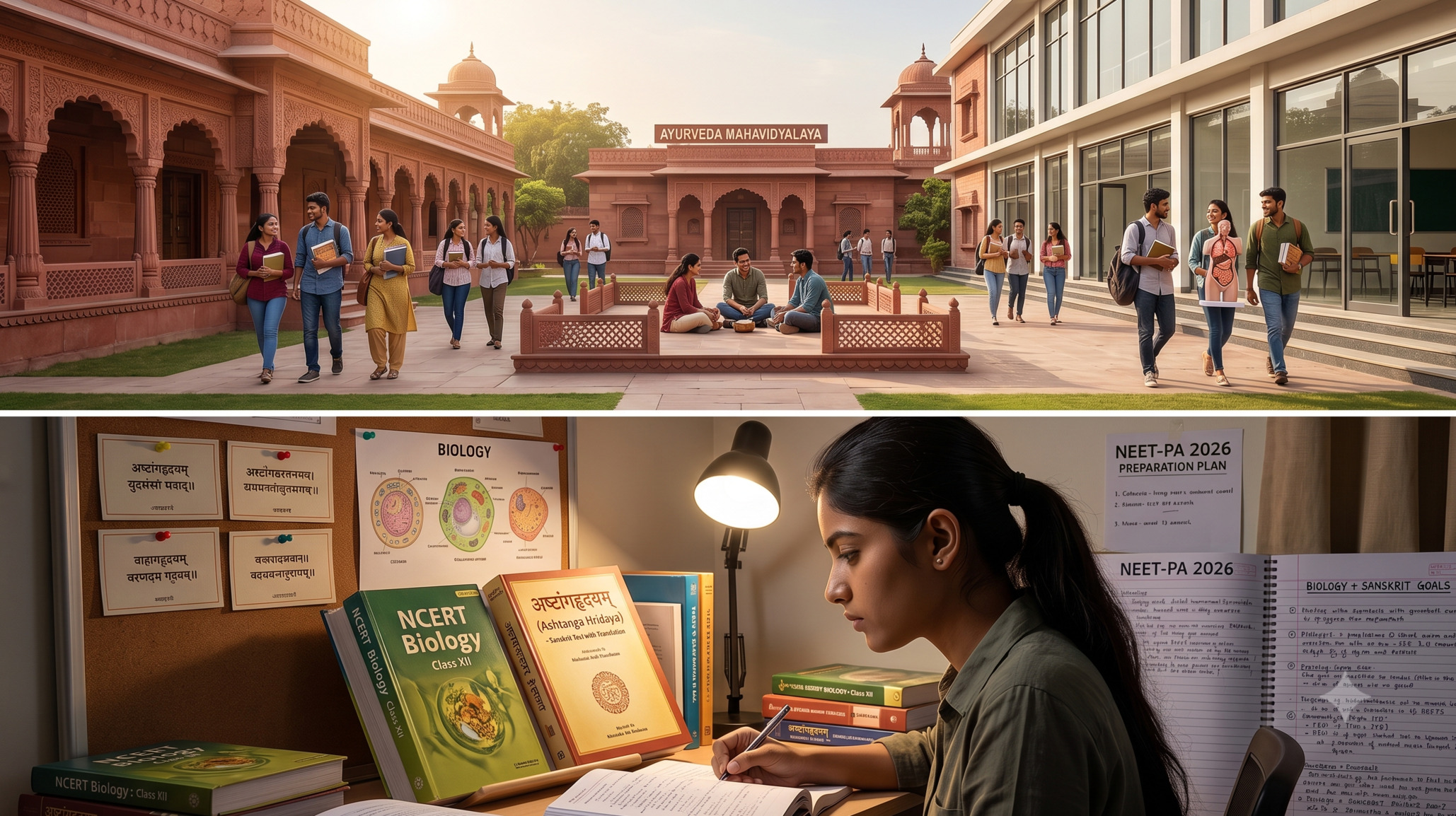
If you’re dreaming of becoming an Ayurvedic doctor while staying rooted in Sanskrit and classical Indian knowledge systems, there’s a new pathway you need to know about. Central Sanskrit University (CSU), New Delhi, has officially announced that it will conduct the National Eligibility-cum-Entrance Test – Pre-Ayurveda (NEET-PA) 2026 for admission to its Pre-Ayurveda program for the 2026-27 academic session.
This is a big development for students who want to pursue Ayurveda through the traditional Gurukulam route rather than the conventional BAMS entrance path. In this guide, you’ll learn everything currently known about NEET-PA 2026 — eligibility criteria, expected dates, the course structure, how to prepare, common mistakes to avoid, and where to get official updates. Since the full detailed notification is still awaited, we’ll also tell you exactly what to watch for so you don’t miss your registration window.
What Is NEET-PA 2026?
NEET-PA stands for National Eligibility-cum-Entrance Test – Pre-Ayurveda. It’s a new entrance examination introduced by Central Sanskrit University to select students for its Pre-Ayurveda program — the foundational stage of a longer, structured pathway toward a BAMS (Bachelor of Ayurvedic Medicine and Surgery) degree.
On July 6, 2026, CSU released an official notification confirming the exam, and news reports indicate that online registration is expected to begin in the third week of July 2026. This makes NEET-PA one of the newest entrance exams in India’s AYUSH education ecosystem, and it’s specifically designed for students who want their Ayurveda education anchored in Sanskrit learning from day one.
Why Central Sanskrit University Is Conducting This Exam
CSU isn’t just a Sanskrit-teaching institution anymore — it’s the nodal agency responsible for reviving and modernizing the Ayurveda Gurukulam model across India. Here’s the bigger picture:
CSU has launched a digital Ayurveda Gurukulam Affiliation Portal, allowing institutions nationwide to apply for affiliation under this new model.
The program follows the NCISM (National Commission for Indian System of Medicine) Pre-Ayurveda BAMS Framework.
CSU plans to run Ayurveda Gurukulam programs on its own campuses too, starting with centers like Nashik and Delhi, before expanding further.
As CSU leadership has emphasized, Ayurveda and Sanskrit are deeply interconnected — understanding classical Ayurvedic texts fully requires a genuine grounding in Sanskrit, which is exactly the gap this program aims to fill.
Course Structure: The 7.5-Year Ayurveda Gurukulam Pathway
Unlike a typical BAMS admission where students go straight into the 5.5-year professional course, the Gurukulam model adds a preparatory phase. Here’s how it breaks down:
Pre-Ayurveda education: 2 years
BAMS (Bachelor of Ayurvedic Medicine and Surgery): 4.5 years
Compulsory internship: 1 year
Total duration: 7.5 years, combining classical Sanskrit-based learning with modern Ayurvedic medical training under NCISM guidelines.
This means NEET-PA is not the same exam as NEET-UG or AIAPGET. It’s specifically the gateway into the Pre-Ayurveda stage, which then feeds into BAMS admission later.
Important Dates
Because the detailed notification is still being finalized, exact dates for the written exam, admit card, and result are not yet public. Here’s what’s confirmed so far:
Event
Status/Expected Timeline
Official notification released
July 6, 2026
Online registration opens
Third week of July 2026 (expected)
Application form submission
To be announced
Admit card release
To be announced
Exam date
To be announced
Result declaration
To be announced
Practical tip: Bookmark the official CSU website (sanskrit.nic.in) and check the “Notifications” section weekly starting mid-July 2026. Government exam bodies often update precise dates with little advance notice, so waiting for a news article to catch up can cost you valuable preparation days.
Eligibility Criteria
While CSU’s detailed eligibility brochure is awaited, based on the Pre-Ayurveda BAMS framework and comparable AYUSH entrance exams, candidates should generally expect requirements along these lines:
Academic qualification: Passed Class 12 (or equivalent) with Physics, Chemistry, and Biology, similar to NEET-UG eligibility norms used for BAMS admissions.
Sanskrit background preference: Given CSU’s mandate, students with a Sanskrit stream background (such as Shastri or equivalent) may get specific consideration or a separate eligibility track — this is a distinctive feature compared to standard NEET exams.
Age criteria: Likely aligned with NCISM/AYUSH admission norms, though CSU may specify its own limits.
Nationality: Indian nationals; NRI/OCI provisions may be clarified in the final notification.
Because this is a first-of-its-kind exam from CSU, don’t rely on assumptions. Always cross-check the final eligibility criteria in the official PDF notification once released — small print details like minimum qualifying percentage or subject combinations can disqualify otherwise eligible candidates.
Exam Pattern (Expected)
CSU has described NEET-PA as being conducted “similar to NEET,” which suggests it will likely be:
An objective-type (MCQ) written examination
Covering core science subjects — Physics, Chemistry, and Biology — since these form the foundation for any Ayurveda-related course
Possibly including a Sanskrit-language component or aptitude section, given the university’s academic identity
Conducted in pen-and-paper or computer-based mode (to be confirmed)
Until the official exam pattern PDF is out, treat this as an informed estimate rather than a confirmed structure.
Step-by-Step Guide to Apply
Once registration opens, the general process is expected to follow this pattern (based on how CSU runs its other entrance and recruitment exams):
Visit the official CSU website (sanskrit.nic.in) and locate the NEET-PA notification link.
Register with your basic details — name, email, mobile number — to generate login credentials.
Fill out the online application form with academic and personal details.
Pay the application fee through the prescribed online payment mode.
Download and save the confirmation page for your records.
Track your admit card closer to the exam date via the same login.
Preparation Tips for NEET-PA 2026
Start with NCERT Biology, Chemistry, and Physics. Since Ayurveda-linked entrance exams typically test Class 11–12 science fundamentals, a strong NCERT base is non-negotiable.
Build basic Sanskrit familiarity. Even if not heavily weighted, some comfort with Sanskrit grammar and vocabulary will help both in the exam and in your later coursework, where Ayurvedic classics are studied in the original language.
Practice with NEET-UG and AIAPGET-style question papers. Until CSU releases sample papers, these are the closest available references for question difficulty and format.
Create a realistic study timetable. Divide preparation time between science revision, Sanskrit basics, and mock tests — don’t neglect any one area.
Join official CSU notification alerts or reliable education news portals. Given how fast these dates can move, timely updates matter as much as subject knowledge.
Common Mistakes to Avoid
Waiting for a “big announcement” instead of checking the CSU site directly. Many students miss registration windows because they rely on secondhand news instead of the primary source.
Assuming NEET-PA and NEET-UG have identical eligibility. They serve different courses; don’t copy-paste requirements.
Ignoring document readiness. Keep scanned copies of your marksheets, ID proof, and photographs ready in advance so you’re not scrambling during a short registration window.
Underestimating the Sanskrit component. Some candidates focus only on science subjects and overlook the university’s core academic identity.
Missing the correction window. Most CSU exams allow a limited-time correction facility for application errors — use it promptly if you spot a mistake.
Latest Trends and Updates
CSU has been actively expanding its academic footprint, recently notifying vacancies and initiatives across campuses including Nashik, Jaipur, and Agartala.
The Ayurveda Gurukulam Affiliation Portal has already drawn public interest, with education observers noting this could reshape how traditional Ayurveda education is delivered in India.
Public reaction has been largely positive, though some educators have stressed the importance of maintaining scientific rigor and international recognition standards alongside the traditional Gurukulam approach.
Key Takeaways
NEET-PA 2026 is a new entrance exam by Central Sanskrit University for admission to the Pre-Ayurveda program.
It feeds into a 7.5-year pathway: 2 years Pre-Ayurveda + 4.5 years BAMS + 1 year internship.
Notification was released on July 6, 2026; registration is expected to open in the third week of July 2026.
Detailed eligibility, exam pattern, and exact dates are still pending official release.
Candidates should prepare using NCERT science fundamentals alongside basic Sanskrit, and monitor sanskrit.nic.in closely.
Conclusion
NEET-PA 2026 represents a genuinely new chapter in Ayurvedic education in India — one that blends classical Sanskrit learning with a structured, NCISM-recognized path to becoming a BAMS graduate. Because this is CSU’s first run of the exam, the safest strategy is to stay close to official updates rather than relying purely on secondhand information. Start your science revision now, build a working familiarity with Sanskrit, and keep the CSU notification page bookmarked so you’re ready the moment registration opens.